





The Death of the “Handoff”
For decades, the web development industry followed a rigid, often frustrating linear path: a designer created a static vision in a tool like Figma, and a developer spent weeks (or months) trying to breathe life into it with code. This “handoff” was the primary source of friction, “design drift,” and budget bloat.
As we move through 2026, that wall has finally crumbled. We have entered the Framer-First Era.
The rise of the “Designer-Developer”—a hybrid professional who can conceive, build, and publish high-performance websites without a traditional engineering team—is no longer a niche trend. It is the gold standard for startups, agencies, and enterprise marketing teams alike.
1. What is “Framer-First” Design?
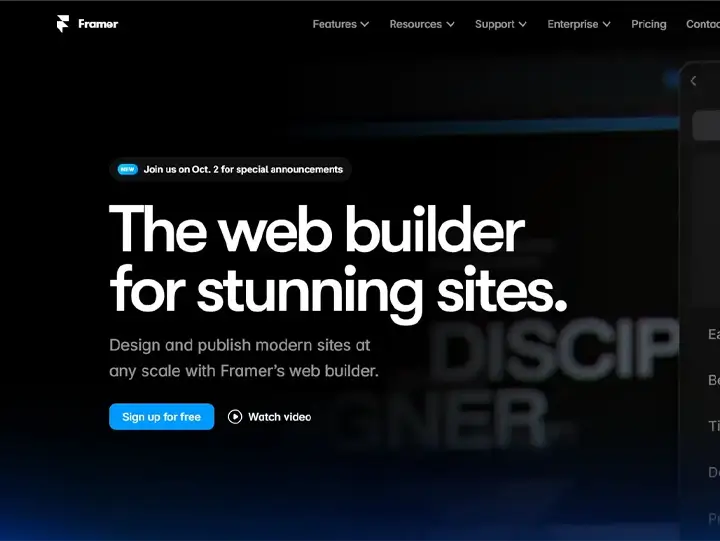
In 2026, “Framer-First” refers to a workflow where the canvas is the production environment. Unlike Figma, which outputs a picture of a website, Framer outputs the website itself.
By prioritizing Framer at the start of a project, you are choosing to:
- Eliminate Translation Errors: What you see on your design canvas is exactly what the user sees in the browser.
- Accelerate Speed-to-Market: Projects that once took 3 months now take 3 weeks.
- Empower Creativity: High-end animations that previously required complex JavaScript libraries like GSAP are now native, drag-and-drop interactions.
2. The Power of AI-Integrated Workflows
The “Framer-First” revolution is fueled by Agentic AI. In 2026, Framer’s AI capabilities have matured from simple layout generation to intelligent design assistants.
AI Wireframing and Layouts
Framer’s AI doesn’t just “guess” what you want. It analyzes your brand’s intent. By inputting a simple prompt—“Landing page for a FinTech SaaS with a dark aesthetic and interactive bento-grid features”—the AI generates a fully responsive, multi-breakpoint structure. This allows you to skip the “blank canvas” phase and move straight into the high-value work of brand refinement.
Automated Responsiveness
One of the greatest time-sinks in traditional development was manual breakpoint management. In 2026, Framer uses Adaptive Layout AI to automatically calculate how elements should shift from a 30-inch ultra-wide monitor to a mobile screen.
3. High-Fidelity Motion as a Standard, Not a Luxury
In the past, “smooth” animations were reserved for brands with massive budgets. In 2026, the web is kinetic.
Framer’s Motion-First approach allows for:
- Scroll-Triggered Storytelling: Immersive experiences that respond to the user’s scroll speed.
- Micro-Interactions: Subtle haptic-like feedback on buttons and links that increase “trust signals” for the user.
- Rive & Lottie Integration: Seamlessly importing complex vector animations that run at 60fps without slowing down the site.
4. Performance & Core Web Vitals in 2026
A common myth is that “no-code” sites are slow. In 2026, Framer has debunked this. Its infrastructure is built on a Global Edge Network, meaning your site is served from the server closest to the user.
Why Framer Wins the Speed Test:
- Optimized CSS/JS: Framer only loads the code needed for the specific page being viewed.
- Next-Gen Image Formats: Automatic conversion to WebP and AVIF ensures your high-res visuals don’t kill your mobile load times.
- Built-in SEO Controls: 2026’s SEO landscape is dominated by AI search (like Perplexity and Gemini). Framer’s semantic HTML structure makes it easy for these AI agents to crawl and index your content accurately.
5. The Economic Impact: 10X Your Output
As a business owner or freelancer, the “Framer-First” era is about ROI.
“In 2026, clients aren’t paying for hours worked; they are paying for results delivered.”
By using Framer, you can offer Fixed-Fee High-Ticket Packages. Because your overhead (the cost of hiring a separate developer) is reduced, your profit margins per project skyrocket. You can now handle 10 projects in the time it used to take to finish one, without sacrificing quality.
6. Framer vs. Webflow vs. Elementor: The 2026 Verdict
While you may work across multiple platforms, it’s important to know where Framer fits in the 2026 ecosystem:
- Elementor (WordPress): Still the king of heavy blogging and deep database integrations.
- Webflow: The go-to for complex SaaS platforms with massive CMS requirements.
- Framer: The undisputed champion for Marketing Sites, Landing Pages, and Portfolios where “vibe” and “motion” are the primary drivers of conversion.
7. The Role of the Designer-Developer
The title “Web Designer” is becoming obsolete. The “Designer-Developer” of 2026 must understand:
- UX Psychology: How to guide a user through a spatial interface.
- Technical SEO: Understanding how to structure headers and metadata for AI search.
- Component Logic: Creating reusable design systems that allow a site to grow without breaking.
8. Case Study: Scaling a Startup in 14 Days
In early 2026, many Series A startups are ditching traditional agencies for “Framer-First” specialists. We recently saw a tech firm migrate their legacy site to Framer.
- Before: 8.2s load time, static design, 2% conversion.
- After: 1.1s load time, immersive 3D motion, 9% conversion. The difference? The Designer-Developer could iterate on the “Psychology of Conversion” in real-time without waiting for a dev ticket to be cleared.
9. Future-Proofing: Beyond the Browser
Framer is already preparing for Spatial Web browsing. As AR/VR headsets become more common in 2026, “Framer-First” sites are uniquely positioned because they are built with “layers” and “depth” in mind. Your 2D website today is the 3D environment of tomorrow.
10. Conclusion: Starting Your Framer-First Journey
The “Framer-First” era isn’t just about a tool; it’s about a mindset shift. It’s about taking total ownership of the digital experience.
If you want to 10X your agency’s output in 2026, you must stop “designing for developers” and start “designing for the web.”